
Fundamental Analysis in Forex
Fundamental analysis in forex forecasts currency direction from the economic and policy conditions behind it, rather than from price history. Institutional macro desks build a fundamental view from five inputs read together — central bank rate bias, institutional positioning, economic data surprises, the prevailing cross-asset risk regime, and fundamental valuation — instead of relying on any single one in isolation.
What Is Fundamental Analysis in Forex
Fundamental analysis asks a specific question: given the economic, monetary policy, and positioning conditions of two economies, which currency should capital flow toward next? It is forward-looking by nature — a currency's exchange rate already reflects everything the market currently knows, so what moves it further is new information that changes the expected path of that economy relative to another.
The dominant driver over medium-term horizons is the interest-rate differential between two currencies, and more specifically the market's expectation of where that differential is heading, not just where it sits today. A central bank that is expected to raise rates faster than another tends to see its currency strengthen, because capital seeks the higher forward-looking, risk-adjusted return. Growth, inflation, employment, and trade data all matter primarily because they feed into that rate-path expectation.
| Input | Typical horizon | What it captures |
|---|---|---|
| Central bank rate bias | Weeks to months | Policy divergence between two currencies and what is already priced for the next meeting |
| Institutional positioning | Weeks | How leveraged funds are already positioned — confirmation or crowding risk |
| Economic data surprises | Days to weeks | Whether incoming data is beating or missing what was already expected |
| Cross-asset risk regime | Days to weeks | Whether carry trades are being rewarded (risk-on) or unwound (risk-off) |
Fundamental vs. Technical Analysis
Fundamental and technical analysis are frequently framed as competing methods, but institutional desks tend to use them sequentially rather than as alternatives. Fundamental analysis identifies which currency pair and direction carries an edge; technical analysis is then used to decide when to act on that view.
| Fundamental analysis | Technical analysis | |
|---|---|---|
| Primary input | Rate bias, positioning, data surprises, risk regime | Historical price, chart patterns, indicators |
| Question answered | Which direction has an edge, and why | When to enter or exit within that view |
| Typical horizon | Medium-term (weeks to months) | Short-term (intraday to days) |
| Failure mode | Correct direction, poor timing | Good timing, no underlying edge |
The Five Building Blocks
Institutional macro desks structure fundamental analysis around five inputs, evaluated together rather than individually. Each answers a different question, and a currency view built from two or more aligning carries materially more weight than any single input in isolation.
- Central bank rate bias — what monetary policy divergence between two currencies implies, and what is already priced in by rate markets ahead of the next meeting.
- Institutional positioning — how leveraged funds are already positioned in a currency, which tells you whether a move is early or already crowded.
- Economic data surprises — whether recent releases are beating or missing consensus forecasts, not just their absolute level.
- Cross-asset risk regime — whether the broader market is in a risk-on or risk-off posture, which governs carry trade flows and funding-currency demand.
- Fundamental valuation — whether a pair is already trading rich or cheap versus a fair value estimated from its own rate, risk, and external-balance drivers, which tells you how much of the fundamental story is already priced in.
Central Bank Policy & Rate Bias
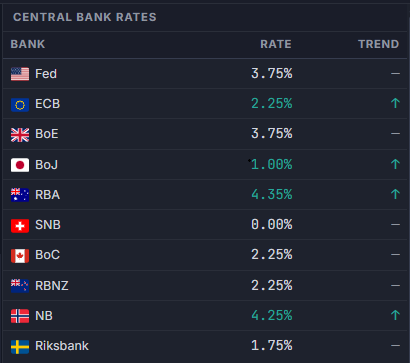
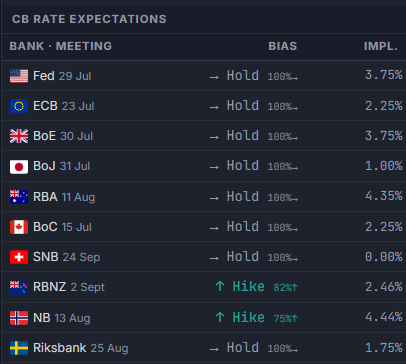
Central bank rate bias is the single most influential fundamental input for medium-term FX direction. What matters is not the current policy rate in isolation, but the expected direction of travel — whether the market is pricing hikes, cuts, or a hold — and how that expectation compares between the two currencies in a pair.
Rate expectations are typically read from OIS-implied pricing rather than from central bank statements alone, since OIS pricing reflects what the market has already priced in ahead of the next scheduled meeting. A currency whose central bank is expected to hike while its counterpart is expected to cut has a clear fundamental tailwind, all else equal — the divergence itself is the signal, not either rate path in isolation.
Institutional Positioning
A fundamental view on direction is incomplete without knowing how institutional players are already positioned. The CFTC Commitments of Traders (COT) report — published weekly for currency futures — breaks down positioning by leveraged funds, providing a proxy for how the institutional community is already leaning on a given currency.
Positioning data answers a question that rate bias and data surprises cannot: is this move early, with room to extend as more participants join, or is it already crowded, with the risk skewed toward a reversal as positioning unwinds? A currency with strongly bullish fundamentals but already stretched net-long positioning carries different risk than the same fundamentals with positioning still near neutral.
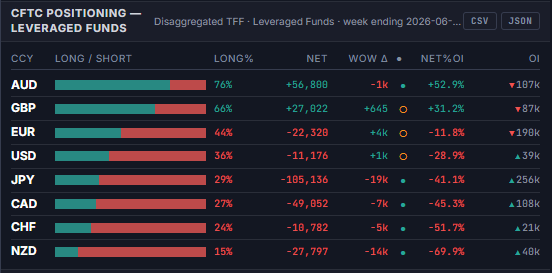
A full breakdown of how to read COT reports — net positioning, historical percentile ranking, and long/short participant detail — is covered in the COT / CFTC Positioning guide.
Economic Data & Surprises
A common beginner mistake is reading economic data in absolute terms. A strong GDP or CPI print is only fundamentally meaningful in the context of what the market already expected. If consensus forecast a stronger number than what was delivered, an objectively solid release can still be a fundamental negative surprise — and can weaken the currency even though the headline figure looks healthy.
Institutional desks track this using a surprise index — a rolling, decay-weighted score of whether a currency's recent data has been beating or missing consensus forecasts — rather than treating each release as an isolated data point.
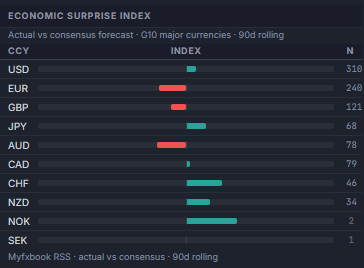
The full methodology — decay weighting, z-score normalization, and how to read a divergence between two currencies' surprise indices — is covered in the Economic Surprise Index guide.
Cross-Asset Risk Regime
Currency direction does not happen in isolation from the rest of the market. In a risk-on regime — rising equities, compressed volatility, tight credit spreads — capital tends to flow toward higher-yielding currencies and away from traditional funding currencies, rewarding carry trades. In a risk-off regime, that flow reverses: funding currencies strengthen as carry positions are unwound and capital seeks safety.
This is why a fundamentally sound rate-differential view can still underperform if the broader risk regime turns against it — a hawkish central bank does not protect a currency from a broad risk-off shock that drives capital toward safe havens regardless of that currency's own rate path.
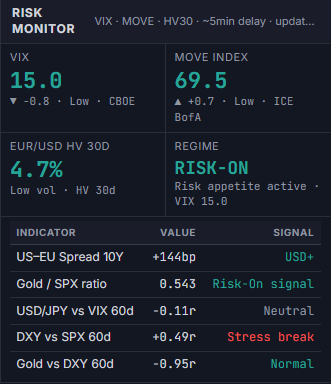
The full regime classification methodology is covered in the Cross-Asset Risk Monitor guide. The same guide's Dollar Smile panel applies this same risk-on/risk-off framing specifically to the dollar — USD tends to strengthen at both tails (safe-haven flows in a genuine risk-off, and yield/growth appeal when US growth outperforms) and underperform in the calm middle regime.
Fundamental Valuation (Fair Value)
The first four pillars above answer which direction has a fundamental tailwind. Valuation answers a different question: how much of that tailwind is already reflected in the current price, and how much cushion or stretch is left before the pair reverts toward a level its own fundamentals justify. A hawkish rate bias supporting a currency that is already trading well above its rate- and risk-adjusted fair value carries more two-way risk than the same rate bias applied to a pair still trading at or below fair value.
The institutional standard for this is a BEER model (Behavioral Equilibrium Exchange Rate) — a regression of the exchange rate against its structural macro drivers, historically the interest-rate differential, a measure of net foreign assets (proxied by the current account), a terms-of-trade proxy (the trade balance), and relative productivity growth (the Balassa-Samuelson effect: an economy whose tradable-sector productivity grows faster than its peers tends to see its real exchange rate appreciate over time). A risk-sentiment variable is commonly added as a desk-level extension to capture the UIP risk premium that a pure rate-differential term misses.
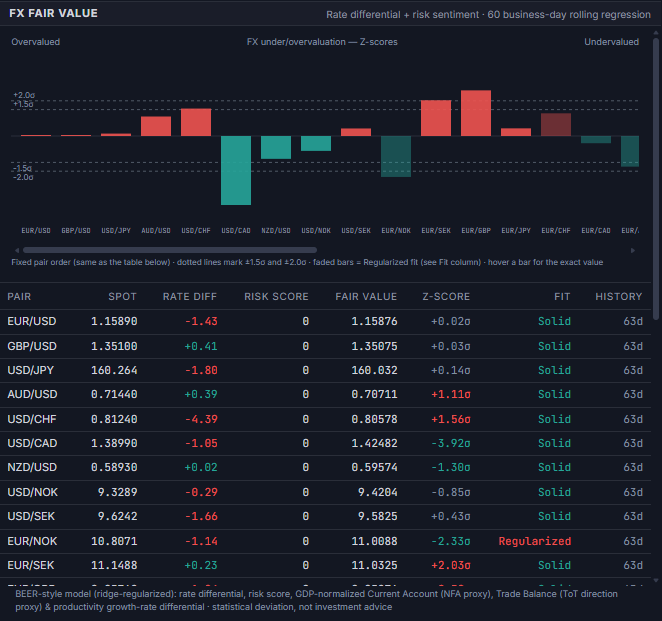
Like the other four pillars, valuation is not a standalone trading signal — a pair can stay stretched away from fair value for a long time if the rate differential or risk-sentiment inputs driving that gap keep moving in the same direction, and a wide Z-score describes a statistical deviation from a fitted model, not a guaranteed reversion timeline or magnitude. It is most useful cross-checked against the other pillars: a currency with a hawkish rate bias, supportive positioning, and improving data surprises that is also trading cheap versus fair value is a stronger combined case than the same three pillars applied to a currency already trading rich.
Reading the Signals Together
No single input above is reliable in isolation. Rate bias can shift on a single dovish comment; positioning can remain crowded for longer than seems rational; a single data surprise can be noise rather than signal; a risk regime can reverse within a session; a valuation gap can persist for months while its own driving inputs keep moving. The institutional approach is to weight a view by how many of the five pillars agree.
| Signal combination | Example | Read |
|---|---|---|
| All five aligned | Hawkish rate bias, positioning still building, positive surprise index, risk-on regime, pair trading cheap vs. fair value | High conviction — every pillar supports the same direction |
| Rate bias vs. positioning conflict | Hawkish rate bias, but positioning already at a stretched net-long extreme | Caution — fundamentals supportive, but crowding raises reversal risk |
| Data surprise vs. risk regime conflict | Improving surprise index, but a risk-off shock is driving flows regardless | Regime dominates — broad risk-off can override a single currency's own data |
| Rate bias vs. valuation conflict | Hawkish rate bias, but the pair is already trading rich versus its BEER fair value (stretched positive Z-score) | Caution — carry story intact, but the valuation cushion is gone, leaving more room to reprice against the position than in its favor |
| All five negative | Dovish bias, crowded net-short, negative surprises, risk-off unwind, pair trading rich vs. fair value | High conviction — every pillar supports weakness |
Alerts & Market Signals: the Synthesis, Automated Per Pair
The web terminal's Alerts & Market Signals panel packages this same cross-checking process into a per-pair, AI-generated read, refreshed four times daily (00:00, 06:30, 14:30, 20:00 UTC, plus a Friday 22:30 UTC refresh once the week's COT report lands). Each card states a setup label, a body paragraph tying the relevant pillars together, and closes with a mandatory three-line footer — Trade bias / Catalyst / Risk — matching the structure of an institutional desk note rather than a plain narrative summary.
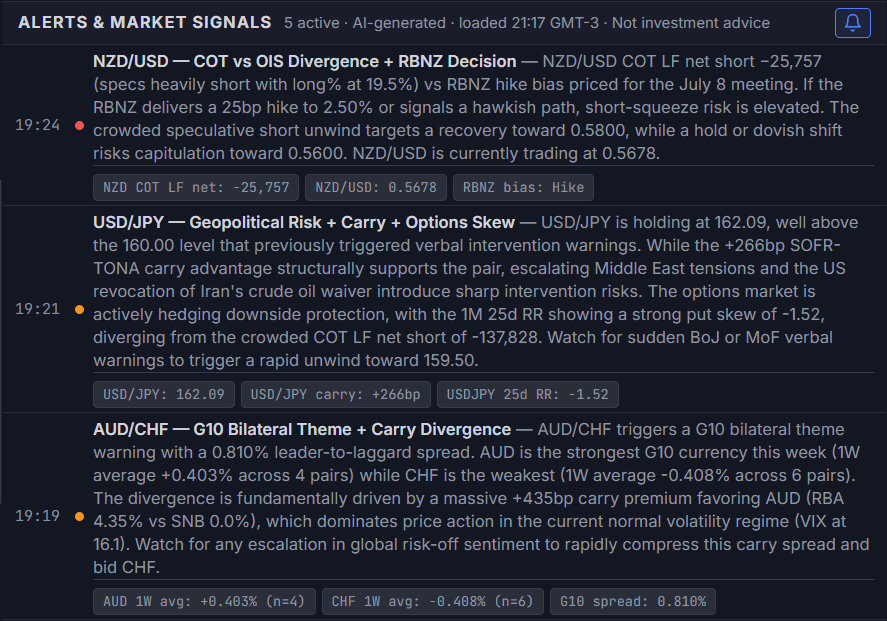
The Risk clause in each footer is the automated version of the "what would invalidate this" check an institutional desk applies before sizing a position — e.g. the CHF/JPY card's risk condition above ("Hormuz tensions de-escalate, removing the geopolitical risk premium") states the specific scenario that would flip the setup, not just a restatement of it. These signals describe market conditions; they are never an instruction to take a specific action. Full panel mechanics — priority dots, browser notifications, and the shorter weekend pre-open format — are covered in the Alerts & Market Signals section of the Dashboard guide.
The EA's Composite Score
The MT5 Expert Advisor packages this same cross-checking process into a single number, rather than requiring a manual review of each pillar in turn. Its Composite Score panel blends CB bias, COT positioning, carry, and the Economic Surprise Index — four of the five pillars covered above, everything except valuation, which is a web-terminal-only panel — together with two additional factors not discussed in this guide, price momentum and retail sentiment, into one per-currency reading on a ±10 scale.
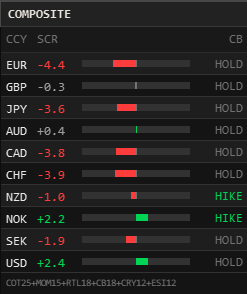
It is a convenience layer over the same underlying panels, not a replacement for understanding why each pillar moved — a high-conviction score is only as reliable as the pillars driving it. The full six-factor weighting, including how the NOK/SEK weight is redistributed in the absence of liquid CFTC futures, is covered in the Composite Score section of the MT5 EA guide.
Common Mistakes
- Reading data in absolute terms. A strong release that misses an even stronger consensus forecast is a fundamental negative, not a positive — the surprise relative to expectations is what moves price, not the headline number alone.
- Ignoring what is already priced in. A widely expected rate hike that arrives as expected often causes little to no FX reaction, since the move was already reflected in the exchange rate beforehand. The reaction comes from the surprise relative to what was priced, not the decision itself.
- Treating a fundamental view as an entry-timing signal. Fundamental analysis identifies medium-term direction; it does not tell you that today is the optimal entry price. Combining it with technical or execution-level timing is standard practice, not optional.
- Relying on a single input. A hawkish central bank alone, without checking positioning or the risk regime, can lead to entering a fundamentally sound view at a structurally poor time — for example, into an already crowded, extended position.
- Ignoring positioning and crowding. The strongest fundamental case can still underperform if positioning is already stretched in that direction, since a large share of the expected move may already be reflected in price.
Limitations
Fundamental analysis is a framework for medium-term directional bias, not a precise timing or execution tool. Several limitations are worth keeping in mind:
- Timing uncertainty. A sound fundamental view can take weeks to play out, or can be delayed indefinitely by an unrelated risk event. It provides direction, not a schedule.
- Data revisions. Economic releases are periodically revised after publication, which can shift a surprise index retroactively. Recent, unrevised data should be weighted with that in mind.
- Regime shocks override slower-moving inputs. A sudden risk-off event can dominate price action regardless of how supportive rate bias or data surprises were beforehand.
- It does not replace risk management. A high-conviction fundamental view is still a probabilistic view, not a certainty, and should be sized and risk-managed accordingly.
For these reasons, fundamental analysis is most effective as one input into a broader framework — cross-checked against positioning, the current risk regime, and, for trade timing, technical analysis — rather than used as a standalone signal.
How the Terminal Implements This Framework
The Global Investing FX Terminal was built around this exact five-pillar structure, so the inputs used in institutional fundamental analysis are available on one dashboard rather than requiring separate manual research for each:
- CB Rates & Bias panel — current policy rate, trend, and OIS-implied bias for all ten G10 central banks.
- COT Positioning panel — weekly CFTC Leveraged Funds net positioning by currency.
- Economic Surprise Index — decay-weighted beat/miss scoring across all G10 currencies.
- Cross-Asset Risk Monitor — current risk-on/risk-off regime classification and its implication for carry.
- FX Fair Value panel — the valuation pillar: a BEER-style ridge-regularized regression showing each pair's Z-score deviation from its rate- and risk-adjusted fair value, for all 32 tracked pairs.
- AI Market Narrative — a synthesis of the panels above, refreshed at each major session transition, so the current read is stated in plain language rather than requiring the reader to cross-reference every panel manually.
- Alerts & Market Signals panel — the same five-pillar synthesis applied per pair rather than market-wide, generated as a structured card with a Trade bias/Catalyst/Risk footer; see Reading the Signals Together above for how to interpret conflicting pillars.
The same data is available in the browser-based web terminal and natively inside MetaTrader 5 through the companion Expert Advisor — see the MetaTrader 5 EA guide for the native MT5 panel layout. FX Fair Value is a web-terminal-only panel, not currently ported to the MT5 EA.
CB rate bias, COT positioning, economic surprises, and the cross-asset risk regime for all G10 currencies are available on the web terminal and natively inside MetaTrader 5 through the companion Expert Advisor — both unlock under a single EA rental on MQL5 Market. FX Fair Value, the valuation pillar, is a web terminal panel.
Frequently Asked Questions
What is fundamental analysis in forex?
Fundamental analysis in forex is the practice of forecasting a currency's direction from the economic, monetary policy, and positioning conditions of its underlying economy, rather than from historical price patterns. It asks which currency's conditions justify capital flowing toward it going forward — driven mainly by relative interest-rate expectations between two economies, since capital tends to flow toward the currency offering the more attractive forward-looking return once risk is accounted for.
What is the difference between fundamental and technical analysis in forex?
Fundamental analysis looks at the economic and policy conditions behind a currency — central bank rate bias, growth and inflation data relative to forecasts, institutional positioning, and risk appetite — to form a medium-term directional view. Technical analysis looks at historical price action and chart patterns to time entries and exits within that view. The two are complementary rather than competing: a fundamental view identifies which direction has an edge, while technical analysis is commonly used to decide when to act on it.
What data is used in forex fundamental analysis?
Institutional fundamental analysis for FX generally combines five inputs: central bank policy rates and forward guidance (including what interest-rate markets are already pricing for the next meeting), institutional positioning data such as the CFTC Commitments of Traders report, economic data releases scored against consensus forecasts rather than in absolute terms, the prevailing cross-asset risk regime, which determines whether carry trades are being rewarded or unwound, and a fundamental valuation estimate — typically a BEER-style regression of rate differential, risk sentiment, and external-balance variables — showing whether a pair is trading rich or cheap versus its modeled fair value. No single input is sufficient on its own; the framework is built from reading all five together.
Can beginners learn forex fundamental analysis without a paid course?
The core framework is a small, learnable set of concepts: relative interest-rate expectations between two economies, whether incoming data is beating or missing forecasts, how institutional players are already positioned, and the current risk appetite regime. What a course typically adds is packaged data and worked examples rather than a fundamentally different method. A dashboard that already aggregates rate bias, positioning, data surprises, and risk regime in one place removes most of the manual data-gathering that otherwise makes the subject feel more complex than the underlying logic actually is.
Is fundamental analysis or technical analysis more reliable for forex trading?
Neither is categorically more reliable; they answer different questions on different time horizons. Fundamental analysis is better suited to medium-term directional bias, since interest-rate and policy divergence tends to play out over weeks and months. Technical analysis is better suited to shorter-term entry and exit timing, since it reacts to price action directly. Institutional desks typically use fundamental analysis to decide which currency pairs to focus on and in which direction, then use technical or execution-level tools to time the trade itself — treating the two as sequential steps rather than substitutes for one another.
What is the institutional framework for fundamental analysis in FX?
Institutional macro desks generally structure fundamental analysis around five pillars evaluated together: central bank rate bias and policy divergence between two currencies, institutional positioning from sources like the CFTC COT report, economic data momentum measured as surprises relative to consensus rather than absolute levels, the prevailing cross-asset risk regime that governs carry and funding flows, and a fundamental valuation model that flags whether a pair is already trading rich or cheap versus its rate- and risk-adjusted fair value. A currency view built from two or more of these pillars aligning carries materially more weight than any single pillar in isolation.
What is FX Fair Value and how does it fit into fundamental analysis?
FX Fair Value is a valuation model — the fifth pillar alongside rate bias, positioning, data surprises, and risk regime — that estimates what a pair's spot rate should be given its underlying macro drivers, then expresses the live spot rate as a Z-score deviation from that estimate. A common institutional approach is a BEER-style (Behavioral Equilibrium Exchange Rate) regression combining the rate differential, a risk-sentiment score, GDP-normalized Current Account and Trade Balance (proxies for net foreign assets and terms of trade), and a productivity growth-rate differential (a Balassa-Samuelson proxy). Valuation answers a different question than the other four pillars: not which direction has a fundamental tailwind, but how much of that tailwind is already priced in, and how much cushion or stretch exists before the pair reverts toward its modeled fair value.