
Rates & Yield Curve — US Treasuries
The US Treasury yield curve is the single most important macro indicator for FX markets globally. It encodes market expectations for growth, inflation, and Federal Reserve policy — and it drives capital flows between currencies through the interest rate differential mechanism.
What It Shows
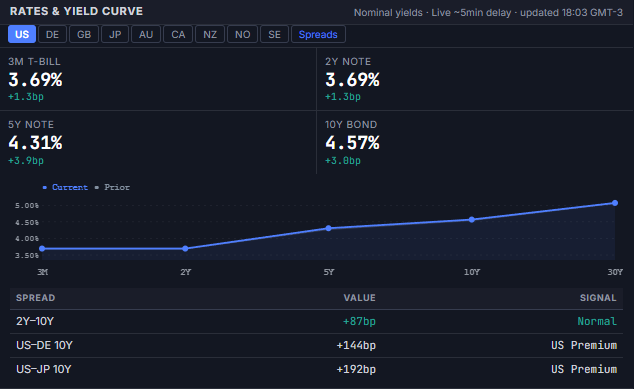
The Rates & Yield Curve section of the terminal covers five US Treasury nominal yields (3-month T-Bill, 2-year Note, 5-year Note, 10-year Bond, 30-year Bond). Four of them — 3M, 2Y, 5Y, and 10Y — are broken out as individual data cells above the chart; the 30Y is not a separate cell in this compact view but is plotted as the final point on the curve chart itself, and all five are broken out together in the detail view (see Detail View & Market Commentary below). Below the cells and chart sits a table of three key spreads: the 2Y–10Y domestic spread, the US–Germany 10Y differential, and the US–Japan 10Y differential.
The 3M, 5Y, 10Y, and 30Y tenors update approximately every 5 minutes during US market hours via live yield tickers. The 2Y tenor is always sourced from FRED's daily DGS2 series — it only changes once per day, even though the panel subtitle labels it "Live" alongside the other four. Outside market hours, or when the intraday feed is unavailable, the 10Y, 2Y, and 5Y tenors fall back to FRED's daily batch values (DGS10, DGS2, DGS5); the 3M and 30Y tenors have no repo fallback and show a dash if the intraday feed fails. The yield curve canvas visualizes the slope and shape of the curve in real time, making it immediately obvious whether the curve is normal, flat, or inverted.
The Five Tenors — What Each Measures
Curve Shape — What It Signals
The relationship between short and long yields — the slope of the curve — has historically been one of the most reliable leading indicators in macroeconomics:
2Y–10Y Spread
The most widely-watched domestic yield curve spread: the difference between the 10-year Treasury yield and the 2-year Treasury yield, expressed in basis points (bps). Calculated as 10Y yield − 2Y yield.
| Value | Signal | FX Context |
|---|---|---|
| +100 bps or more | Strongly normal curve | Robust growth expectations. Strong carry trades. Risk-on currencies supported. |
| +50 to +100 bps | Moderately normal | Healthy environment. Gradual USD normalization cycle typically ongoing. |
| 0 to +50 bps | Flat / Flattening | Late-cycle signals. Watch for growth deceleration. Begin monitoring JPY. |
| 0 to -50 bps | Mild inversion | Recession risk on the horizon. Carry trade vulnerability rising. Defensive posture. |
| -50 bps or deeper | Deep inversion | Historically high recession probability within 12–18 months. Risk-off bias. |
International Yield Spreads
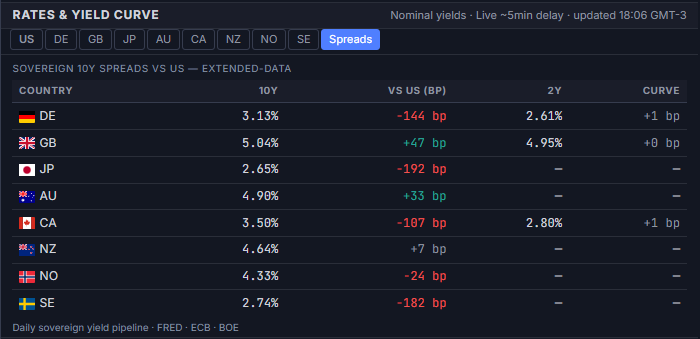
The US pane's fixed spread table shows two cross-country 10Y yield differentials by default — US–DE and US–JP — directly alongside the US curve, since these are the two structural drivers most consistently watched for EUR/USD and USD/JPY. These spreads work through the interest rate parity mechanism — capital flows toward higher-yielding sovereign debt, bidding up that country's currency. The full panel covers nine economies in total; see Country Tabs & Sovereign Spreads below for the complete set.
US–DE 10Y Spread (EUR/USD Proxy)
The difference between the US 10-year Treasury yield and the German 10-year Bund yield. This spread is the primary structural driver of EUR/USD over medium-to-long timeframes.
When the US–DE spread widens (US yields rise faster or fall slower than German yields), the USD becomes more attractive relative to the EUR, and EUR/USD tends to fall. When the spread narrows, EUR/USD tends to rise.
The correlation between US–DE 10Y spread and EUR/USD typically runs at -0.80 or better over rolling 6-month windows. Divergences between the spread and EUR/USD price action are often mean-reversion setups.
US–JP 10Y Spread (USD/JPY Driver)
The difference between the US 10-year Treasury yield and the Japanese 10-year JGB yield. This is arguably the single most important structural driver of USD/JPY — the pair with the world's highest daily volume.
Japan's yield curve control (YCC) policy (now largely unwound as of 2024) historically capped JGB yields near 0%, meaning the US–JP spread widened and narrowed almost entirely based on US yield movements. This made USD/JPY one of the purest expressions of US rate expectations in FX markets.
The terminal displays the signal as US Premium when the US 10Y yield exceeds Japan's (spread positive — carry incentive to be long USD/JPY), or JP Premium when the Japanese 10Y yield exceeds the US (spread negative — carry incentive compressed or reversed). The spread value is shown in basis points alongside the signal.
Country Tabs & Sovereign Spreads
Above the US yield grid, a row of country tabs (US · DE · GB · JP · AU · CA · NZ · NO · SE · CH) lets you switch the panel to that country's own yield data — its own tenor grid and curve where available, sourced from the same daily G10 rates data as the US panel. This covers all ten G10 economies directly.
A final Spreads tab replaces the country grid with a single consolidated table: each of the nine non-US G10 economies shown above, with its 10Y yield and spread versus the US 10Y in basis points, its 2Y yield and 2Y spread versus the US in its own column, and a curve-slope indicator. This is the fastest way to scan all cross-country spreads at once rather than switching tabs one at a time.
2Y Momentum Screener
A second tab next to Spreads, ranking the nine non-US G10 economies by how fast their 2Y-vs-US spread is moving — the 5-business-day and 20-business-day change in basis points, sorted by |5D change|. The 20-day change is also shown as a small centred bar, extending right (green) or left (red) from the middle of the row.
The point of this screener is timing, not level: a currency's 2Y-vs-US spread can sit far from zero and still be stable, or sit close to zero and be moving fast. A spread that is widening or narrowing quickly is repricing policy expectations right now — often before that shows up in spot, since positioning and carry flows tend to follow the rate move rather than lead it.
Detail View & Market Commentary
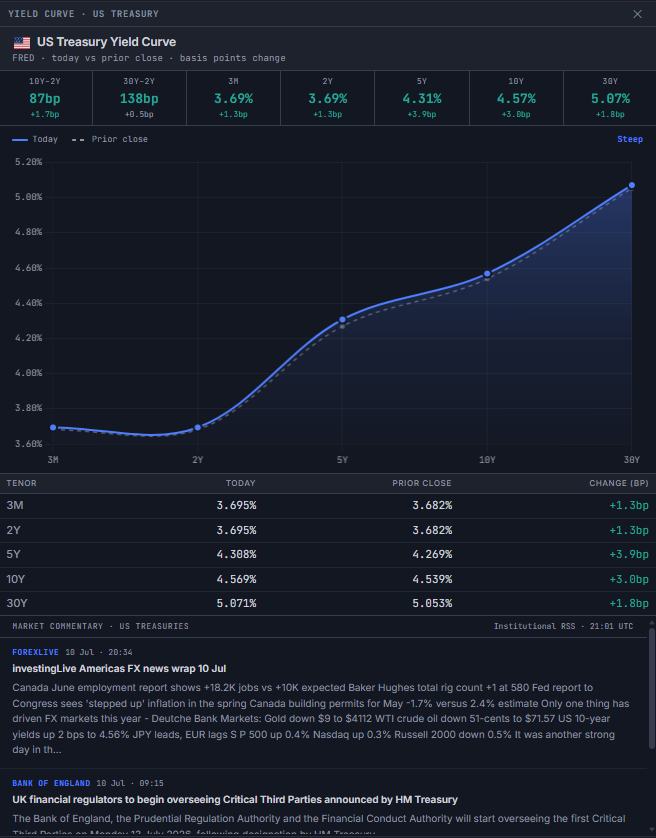
Clicking the Rates & Yield Curve panel opens a detail view with a larger curve chart, the 10Y–2Y and 30Y–2Y spread metrics, and the full tenor table (today, prior close, change in bp). Below the table, a Market Commentary block surfaces up to three of the most recent institutional headlines specifically about US Treasury yields and the yield curve — the same Bloomberg/Refinitiv-style commentary pattern used in the CB Rates detail view, applied here to Treasury-specific coverage rather than a single central bank.
Articles are pulled from the terminal's news pipeline and filtered by topic — Treasury yield, yield curve, and tenor-specific terminology (10-year, 2-year, 30-year, T-Bill) — rather than by currency tag, since a generic "USD" filter would also surface unrelated USD headlines (payrolls, CPI, Fed speeches with no bearing on the curve itself). Each entry shows the source, a relative timestamp, the headline (linked to the original article), and a short excerpt. If no qualifying article exists in the current news window, the panel shows an empty state rather than an unrelated headline.
Practical FX Implications
Use the Rates section alongside the Cross-Asset and CB Rates panels for the highest-conviction signals:
- US 10Y rising + DXY strengthening + US–JP spread widening → consensus signal for USD/JPY upside
- US 2Y falling sharply after CPI miss → Fed cut expectations repriced → short USD, long EUR and commodity pairs
- Curve inverting deeper while VIX rising → risk-off regime, defensive currencies (JPY, CHF) favored
- US–DE spread narrowing while ECB holds rates → EUR/USD upside, especially if EUR also has inflation convergence
- Bear steepening (10Y rising, 2Y stable) → watch for gold and AUD pressure as real rates rise
Current US Treasury curve, 2Y–10Y spread, international yield differentials, and CB rate trajectories across ten G10 economies — all in one panel. Available on the web terminal and natively inside MetaTrader 5 through the companion Expert Advisor — both unlock under a single EA rental on MQL5 Market.
Frequently Asked Questions
What is the yield curve and why does it matter for FX?
The yield curve plots government bond yields across maturities (e.g. 2Y, 5Y, 10Y, 30Y) for a given country. Its shape and level reflect market expectations for growth, inflation, and central bank policy. In FX, a currency's yield curve relative to its peers — particularly at the short end — is a key driver of rate-differential-based flows, since capital tends to move toward higher-yielding currencies when risk appetite allows.
What does the 2Y-10Y spread signal?
The 2Y-10Y spread is the difference between the 10-year and 2-year government bond yields. A positive spread (normal curve) reflects expectations of steady growth; a flattening spread signals the market pricing in slower growth or policy tightening; a negative spread (inversion) has historically preceded recessions and often triggers safe-haven and rate-cut-expectation flows.
How do international yield spreads affect currency pairs?
A currency pair's exchange rate is closely linked to the yield spread between the two countries' government bonds at comparable maturities. For example, a widening US-Germany 10Y spread in favor of US yields tends to support USD strength against EUR, all else equal, since it reflects a growing relative return advantage for USD-denominated fixed income.
How often is yield curve data updated?
Sovereign bond yield data across the covered tenors and countries is refreshed daily from official and institutional sources, with the terminal displaying the current curve alongside recent changes for each tracked tenor.