
Currency Strength Indicator for MetaTrader 5
How the Currency Strength Index (CSI) works, how to read it inside the web terminal, and how to install the standalone CSI Currency Strength indicator on a MetaTrader 5 chart. If you want a single read on which G10 currency is genuinely strong or weak right now — rather than piecing it together pair by pair — this guide covers the methodology and both places it's available.
What the CSI Is
The Currency Strength Index (CSI) is a composite measure of how strong or weak each G10 currency is relative to all the others at once, rather than against a single counterpart. A currency can be rising against one pair while falling against another; the CSI nets these movements together into one ranking per currency, so a trader can see which side of a pair is actually driving the move.
Methodology
Each currency's score is built from the cumulative log-return of every pair it appears in over the selected horizon: the return is added when the currency is the base of the pair and subtracted when it is the quote, so a currency's score reflects its net direction across the entire G10 cross-rate set rather than one isolated pair.
On the standalone MT5 indicator, this goes a step further. Rather than a single lookback, it computes the return independently across three horizons — short, medium and long — and normalises each into a cross-sectional z-score, so readings are comparable across currencies and over time regardless of each pair's raw volatility. The three z-scores are then combined with configurable weights (25% short / 35% medium / 40% long by default) into one composite score per currency. This multi-lookback weighted approach follows the momentum model of Asness, Moskowitz & Pedersen (2013) and is designed specifically to avoid the "cliff-edge" artifact a single fixed lookback produces, where a score can jump sharply the moment one old data point rolls out of the window.
CSI on the Web Terminal
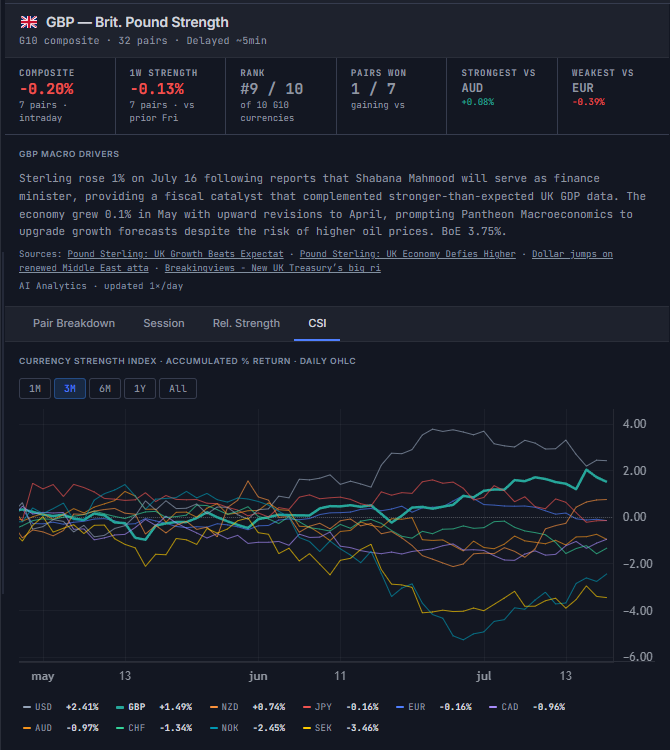
On the web terminal, CSI appears as a tab inside the Currency Strength Heatmap modal: a multi-series chart showing the cumulative log-return of each of the 10 G10 currencies, computed from the full OHLC dataset across all 32 pairs. A timeframe selector (H1 / H4 / 1D / 1W) picks the bar granularity the returns are computed from — H1 and H4 use the same intraday OHLC data the main price chart uses, 1D is the original daily view, and 1W resamples the daily series to weekly closes — and each timeframe has its own set of period presets (e.g. 1D offers 1M/3M/6M/1Y/All; H1 offers shorter, intraday-appropriate windows). The focal currency is highlighted and all ten series update on period or timeframe selection without a full page reload. A crosshair tooltip shows all 10 values simultaneously, ordered strongest to weakest, and a legend below the chart ranks each currency by its return over the selected period. A separate CSI Snapshot table shows each currency's accumulated return, drawdown (low), peak (high), and peak-to-trough range for the same period.
CSI on MetaTrader 5
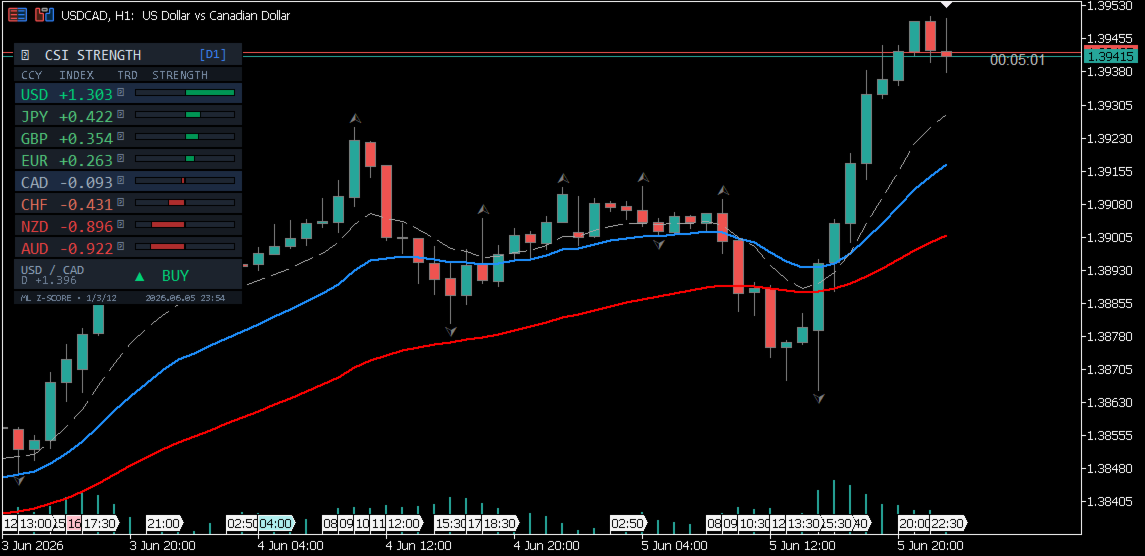
For traders who want the same read without switching to a browser, CSI Currency Strength is available separately as a native MetaTrader 5 indicator (MQL5 Market product #180317). It renders currency strength directly as a panel overlay on the chart, using a multi-lookback weighted z-score model (short/medium/long horizons, based on Asness, Moskowitz & Pedersen 2013), covering 28 pairs across eight currencies, each color-coded for quick scanning.
How to Read It
Currencies at the top of the ranking have been broadly bought across the pair set over the selected horizon; currencies at the bottom have been broadly sold. The distance between the strongest and weakest currency — the range — gives a sense of how dispersed the current regime is: a wide range points to a clear directional theme (e.g. a broad dollar move), while a narrow range suggests no single currency is dominating and moves are more pair-specific.
Because the score is cumulative over the selected period, switching horizons — or timeframes — can reorder the ranking: a currency can be the weakest performer over the past month while still net-strong over the past year, or look different intraday (H1/H4) than it does on the daily/weekly view. Comparing more than one period is generally more informative than reading a single one in isolation.
CSI vs. a Single Pair Chart
A single pair chart only shows the relationship between two currencies. If EUR/USD is rising, that could mean EUR is strong, USD is weak, or both — a single chart can't distinguish between those cases. The CSI resolves this by aggregating each currency's performance across every pair it trades in, isolating the currency-specific component of the move from the pair-specific one.
Further Reading
For the full calculation methodology across every terminal panel — z-score normalisation, OIS-implied probability mechanics, and documented limitations — see the published methodology document:
A native MetaTrader 5 panel overlay — z-score currency strength across 28 pairs and eight currencies, color-coded for quick scanning. The same data is also available on the web terminal, with no installation required.