
CFTC COT Positioning
The CFTC Commitments of Traders report is one of the most valuable publicly available data sets for FX traders. It reveals what large institutional speculators are actually positioned for — not what they say, but what they have real money on.
What Is the COT Report?
The Commitments of Traders (COT) report is a weekly publication from the US Commodity Futures Trading Commission (CFTC). It shows the aggregate open positions of different categories of traders in futures and options markets regulated by the CFTC — including currency futures traded on the Chicago Mercantile Exchange (CME).
For FX traders, the report provides a window into the positioning of the most sophisticated market participants: hedge funds, commodity trading advisors (CTAs), proprietary trading firms, and other large speculative accounts. This is institutional-level data, published by the CFTC every Friday afternoon.
CFTC.gov. Data is updated weekly (Friday release covers positions as of the prior Tuesday). The panel header shows the "week ending" date so you always know how current the data is.
Reading the COT Panel
The terminal displays COT data for AUD, CAD, CHF, EUR, GBP, JPY, and NZD futures (all quoted vs. USD — the CFTC does not publish a standalone USD futures contract directly comparable to the others, so USD does not appear as its own row). Each row shows the long/short bar, Long%, net contracts, the week-over-week net change (WoW Δ), an LF/AM alignment dot, net as % of LF open interest (Net%OI), and total LF open interest (OI):
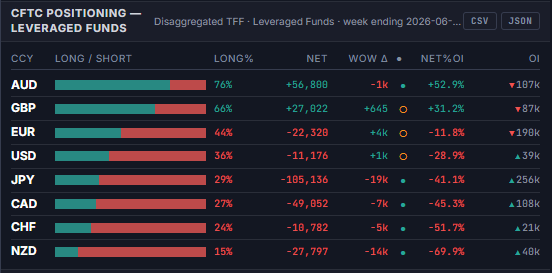
The horizontal bar visualizes the long/short split. Green fills from the left (longs), red fills from the right (shorts). A bar extending past the midpoint on the green side means more speculative longs than shorts. Past the midpoint on the red side means net short positioning.
COT in the Pair Detail strip — dual-leg display for cross pairs
When you click any pair to expand its inline detail, the COT Positioning section adapts to the pair type:
- USD majors (EUR/USD, GBP/USD, etc.): Single leg — LF Net, AM Net, and LF Open Interest for the base currency vs USD. The CFTC data directly reflects the pair.
- Cross pairs (EUR/GBP, GBP/JPY, etc.): Two independent legs shown — base currency and quote currency separately, each with its own LF Net, LF WoW Δ, and Net%OI. Both values are raw CFTC figures as reported (no inversion). The footer line summarises alignment: GBP LF Long · JPY LF Short · aligned means both legs favour the same directional bias for the cross (long base, short quote = bullish cross).
Full Breakdown — expanded view
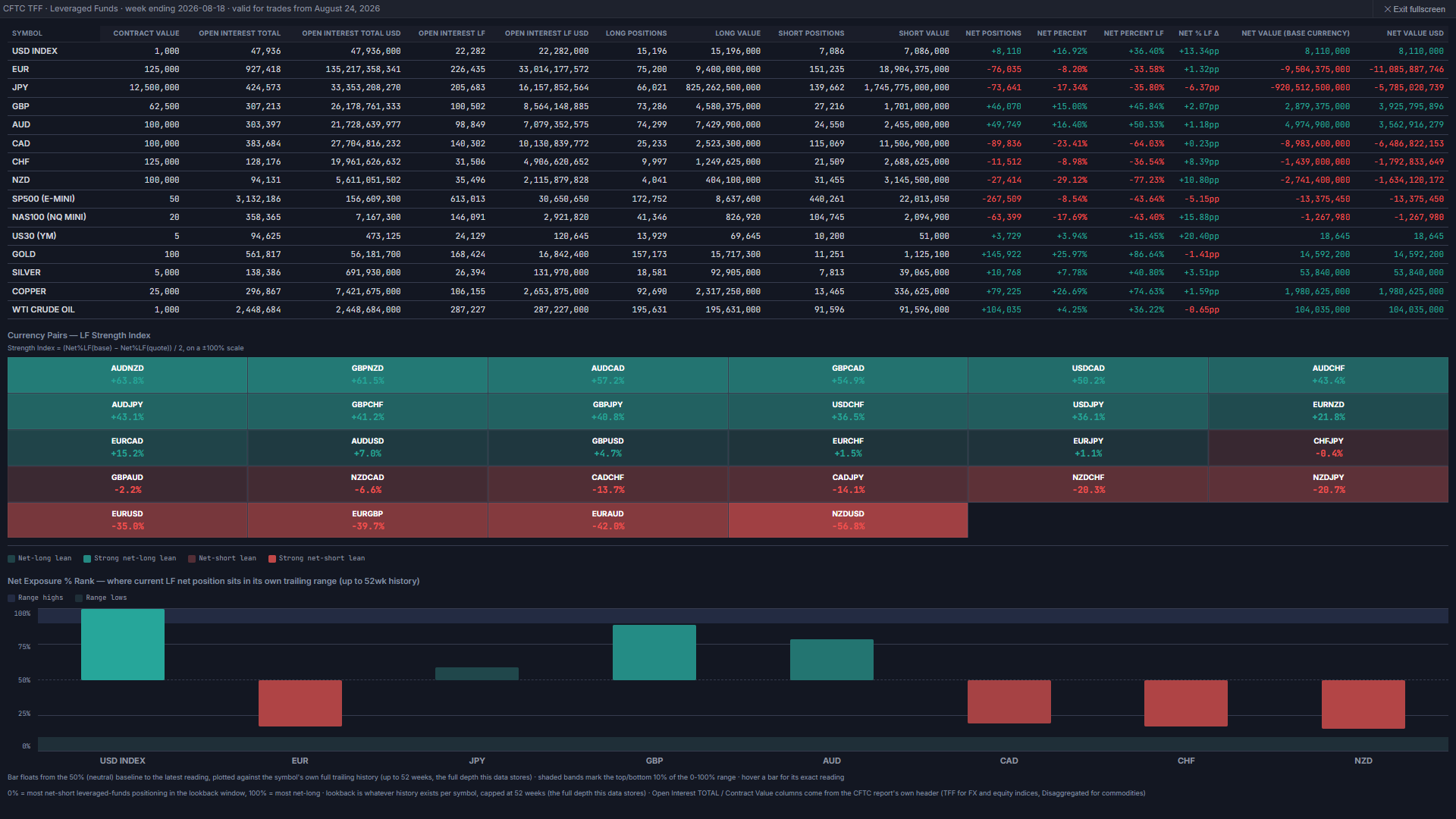
A ⛶ button in the panel header opens the Full Breakdown, a fullscreen expanded view of the same weekly CFTC release. Unlike the docked panel's separate FX / Indices / Commodities tabs, the Full Breakdown lists every covered symbol — FX currencies, equity indices (SP500, NAS100, US30), and commodities (Gold, Silver, Copper, WTI Crude Oil) — together in one combined table. Each row carries the full column set: Contract Value, Open Interest (total and per-contract value), Open Interest LF (total and USD), Long/Short positions and value, Net Positions, Net Percent, Net Percent LF, Net % LF Δ, and Net Value in both base currency and USD.
Below the table, the Currency Pairs — LF Strength Index grid normalizes Leveraged Funds positioning per pair on a ±100% scale: Strength Index = (Net%LF(base) − Net%LF(quote)) / 2. Pairs are ordered strictly by value, from the strongest net-long lean to the strongest net-short lean, with four-tier color banding (net-long lean, strong net-long lean, net-short lean, strong net-short lean). This grid is currency-specific — it doesn't extend to the indices or commodities rows in the table above it.
Underneath the grid, the Net Exposure % Rank chart shows where each currency's current LF net position sits within its own trailing range (up to 52 weeks — capped at whatever history a symbol actually has). 0% is the most net-short a currency has been in its own lookback window, 100% is the most net-long, and each bar floats from the 50% neutral baseline to the latest reading — so a bar near a shaded top or bottom band flags positioning that's stretched relative to its own recent history, independent of how large the raw net figure looks next to other currencies.
Net Contracts
Net contracts — shown as the Net column — is Leveraged Funds' long positions minus their short positions: Net = LF longs − LF shorts. It is the single most-referenced number in the panel because it condenses direction and conviction into one signed figure: positive means speculators are net long that currency vs. USD, negative means net short.
Net alone tells you the current state. Pairing it with the WoW Δ column — the change in Net since the prior week's release — tells you the trend: whether that positioning is building, fading, or reversing. A large net position with a shrinking WoW Δ is a different signal than the same net position still expanding week over week.
Long %
Long% is the share of total Leveraged Funds open interest held on the long side: Long% = longs / (longs + shorts) × 100. It is the same information as Net expressed as a ratio rather than an absolute contract count, which makes it easier to compare positioning across currencies with very different open interest sizes (e.g. EUR vs. CHF).
The panel's rows are sorted by Long% descending by default — the most bullishly positioned currencies surface at the top, the most bearishly positioned at the bottom, so the full cross-currency picture is scannable at a glance without opening any single row.
Open Interest (OI)
The OI column shows the total Leveraged Funds open interest for each currency — the sum of all long and short contracts held by speculative accounts (hedge funds, CTAs, prop trading firms). This is distinct from net positioning: it measures the total size of the speculative bet, not its direction.
Open interest is the institutional standard for gauging conviction and participation level in a positioning move. It answers the question: is the current net position backed by large, active participation, or is it a thin, easy-to-unwind position?
| OI Change | Net Direction | Interpretation |
|---|---|---|
| Rising OI ▲ | Net long growing | New money entering long — strong conviction |
| Rising OI ▲ | Net short growing | New money entering short — strong bearish conviction |
| Falling OI ▼ | Net improving | Shorts covering, not fresh longs — weaker signal |
| Falling OI ▼ | Net deteriorating | Longs liquidating, not fresh shorts — trend exhaustion risk |
A directional arrow (▲ green / ▼ red) appears alongside the OI number when the prior week's data is available, showing whether participation is expanding or contracting week-over-week.
The COT Detail Modal
Clicking any currency row in the COT panel opens the institutional COT detail modal — a full-screen overlay (bottom sheet on mobile) with five tabs that provide progressively deeper analysis for that currency.
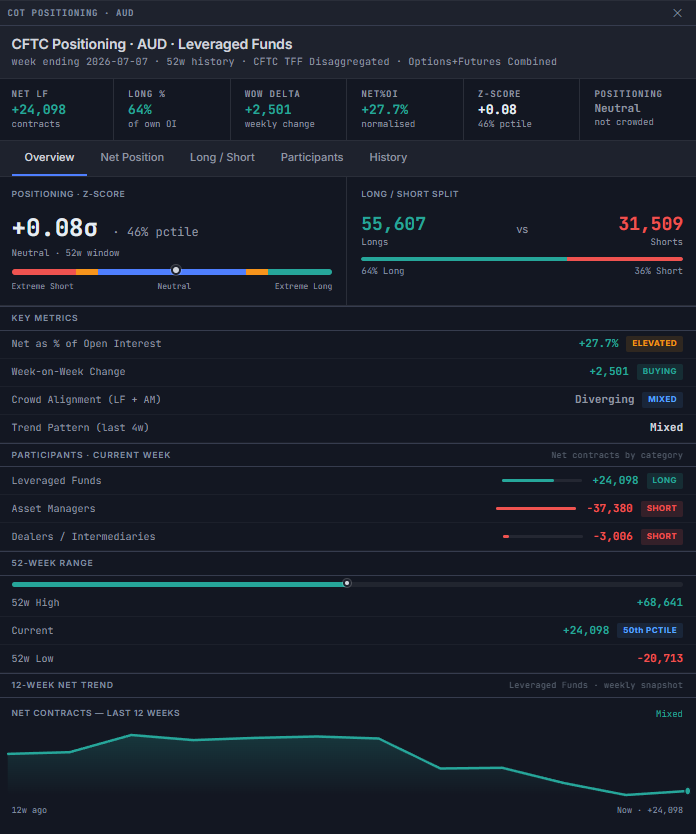
Overview tab
The default tab. Organized in two rows:
- Top row — Positioning Gauge (left): A visual spectrum from Extreme Short (<−2σ) to Extreme Long (>+2σ), with a pin showing where current LF net positioning falls within the trailing 52-week history. Below the gauge: z-score, historical percentile, and label (e.g. Crowded Short · 22nd percentile).
- Top row — Long / Short Split (right): The absolute long and short contract counts and a proportional bar between them, showing LF long% and short%.
- Key Metrics section (full-width): Net%OI, Week-on-Week change with BUYING/SELLING badge, LF/AM crowd alignment, and 4-week trend pattern (Accumulating / Distributing / Mixed).
- Participants section (full-width): A mini bar-chart row for each category (Leveraged Funds, Asset Managers, Dealers / Intermediaries) with net contracts and LONG/SHORT/FLAT badge. Bars are proportionally scaled to the largest absolute net.
- 52-Week Range section (full-width): A range bar and table showing 52w High, Current, and 52w Low net contracts with the current position's percentile rank.
- 12-Week Net Trend section (full-width): A 12-week SVG sparkline of LF net contracts with a trend label (e.g. Accumulating · 3 consecutive weeks).
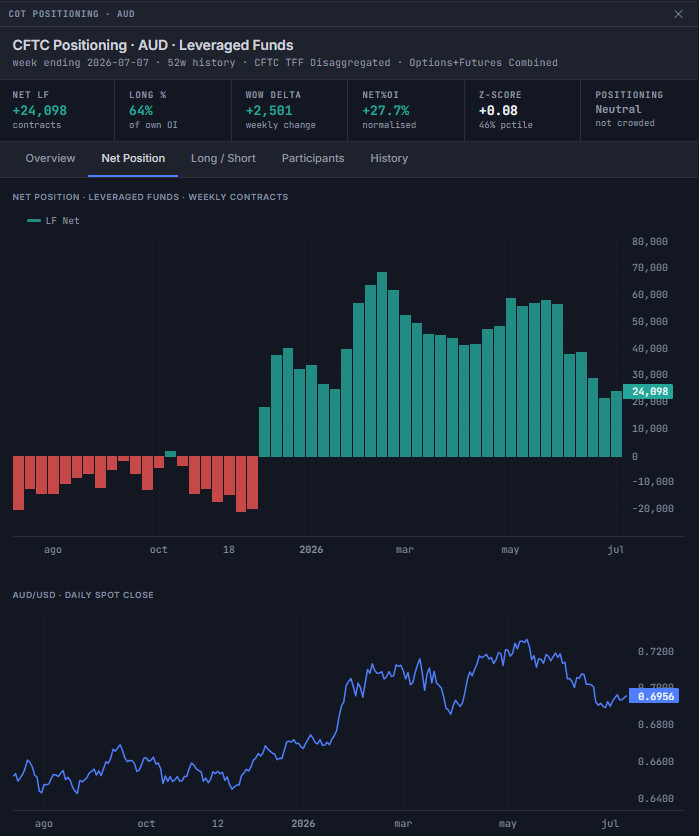
Net Position tab
A weekly bar chart of LF net contracts over the available history (up to 52 weeks). Bars are green (teal) for net-long weeks and red for net-short weeks — direction is encoded in both the bar color and the y-axis. This matches the terminal's standard up/down color convention. Below the net-position chart, a second panel plots the currency's daily spot close against USD over the same period, so a positioning shift can be read directly against price action.
Long / Short tab
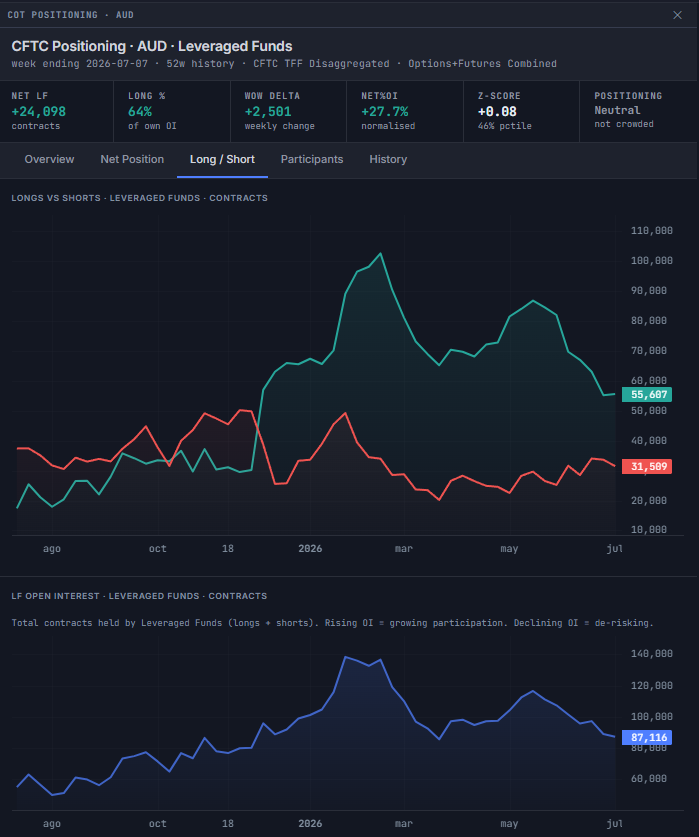
A weekly line chart overlaying LF longs (teal) and LF shorts (red) on the same scale. Where the two lines converge, the position is close to neutral. Where they diverge, the gap represents the absolute size of the net position. Useful for seeing whether a net move is driven by new positions being added or existing positions being unwound. Below it, a second chart plots total LF open interest (longs + shorts combined) over the same history, so a positioning move can be checked against whether participation is expanding or contracting.
Participants tab
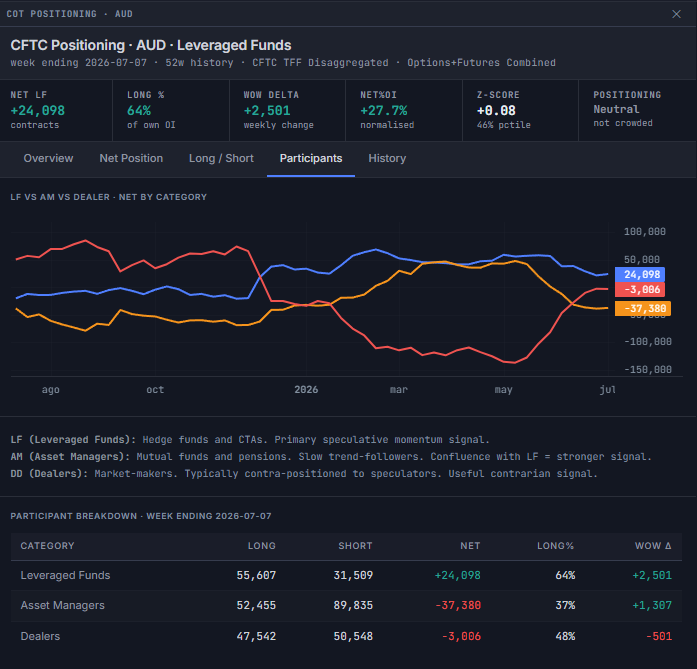
A multi-line chart overlaying LF, Asset Manager, and Dealer net positions over the available history. Each series uses a fixed color (LF = blue, AM = orange, DD = red) so they render consistently on all devices. Below the chart, a brief text legend explains each category's typical behavior, followed by a table breaking down long, short, net, long%, and week-over-week change for each of the three categories at the current week.
History tab
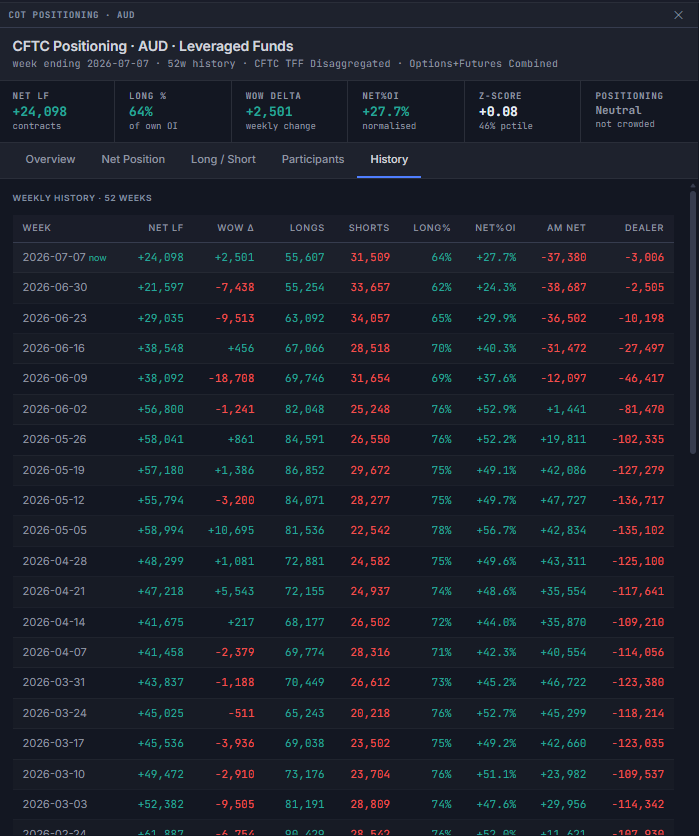
A scrollable table of the last 52 weeks of raw CFTC data for the selected currency, with columns: Week, Net LF, WoW Δ (week-over-week change in net), Longs, Shorts, Long%, Net%OI, AM Net, and Dealer Net. This is the same source data that feeds all other tabs, presented in full for manual analysis or reference.
Trader Categories
The CFTC Traders in Financial Futures (TFF) report splits open interest into distinct trader categories. The terminal tracks the three most relevant to FX positioning analysis:
- Leveraged Funds (LF) — hedge funds, CTAs, and other money managers trading with leverage for speculative or relative-value purposes. This is the terminal's primary series: the main panel's Net, Long%, WoW Δ, and Net%OI columns are all LF figures. LF is the fastest-moving, most trend-sensitive category and the one most often referenced as "the COT signal."
- Asset Managers (AM) — institutional investors, pension funds, and other real-money accounts. AM positioning tends to be stickier and more structurally driven than LF, which is why the LF/AM alignment dot matters: when both categories agree, the positioning view is reinforced by two independent, differently-motivated participant types.
- Dealers / Intermediaries — banks and swap dealers that mostly warehouse risk from client flow rather than expressing directional views. Because dealers are largely reactive, a dealer book positioned opposite to LF at an extreme often reflects dealers absorbing the other side of a crowded trade — see the Dealer divergence callout under the Participants tab.
All three categories are visible together in the COT modal's Participants tab and Participants section of the Overview tab, and as columns (AM Net, Dealer Net) in the History tab table.
Indices & Commodities
Above the FX rows, the COT panel header carries three asset-class tabs: FX (the 7 currencies covered above), Indices (S&P 500, Nasdaq 100, Dow Jones 30), and Commodities (Gold, Silver, Copper, WTI Crude). Indices and Commodities are supplementary context to the terminal's core FX identity, not additional core inventory — useful for cross-referencing a currency's positioning against related asset flows (e.g. AUD vs. Copper, CAD vs. WTI, safe-haven flows into Gold vs. JPY/CHF).
The Disaggregated report's three tracked categories, in place of TFF's LF/AM/Dealers:
- Managed Money (MM) — hedge funds and CTAs. This is the Disaggregated report's primary speculative category and the direct commodity analog of TFF's Leveraged Funds; the terminal treats it as the main signal for Commodities-tab rows the same way LF is the main signal for FX/Indices rows.
- Swap Dealers (SD) — banks and swap dealers hedging OTC and index exposure. This is the secondary category, analogous to TFF's Asset Managers in that it provides a second, differently-motivated read: when Managed Money and Swap Dealers move in the same direction, it reinforces the signal.
- Producer/Merchant (PM) — commercial hedgers: producers, processors, and end users of the physical commodity. Typically positioned contrary to speculators, since they hedge production or input costs rather than speculate on price direction — a useful contrarian signal, the commodity equivalent of watching Dealer positioning on the FX side.
The panel header, row layout, click-through to the detail modal, and every tab inside that modal (Overview, Net Position, Long/Short, Participants, History) work identically across all three asset classes — only the category labels and the underlying CFTC report change. A Commodities-tab row's header reads CFTC Disaggregated · Options+Futures Combined where an FX or Indices row reads CFTC TFF, so the report family is always visible at a glance.
Signal Logic
Rather than a single composite score, the terminal surfaces COT positioning as a small set of independent, plain-language signals — visible as the Signal Summary block in the COT detail modal's Overview tab. Each signal is generated from a distinct piece of the underlying data:
| Signal | Trigger |
|---|---|
| LF net long / LF net short | Sign of the current LF Net figure |
| LF/AM aligned / diverging | Whether LF Net and Asset Manager Net share the same sign |
| Crowded trade / Not crowded | Whether the LF Net z-score (vs. 52-week history) is at or beyond ±1.5σ |
| Dealers contra-positioned / aligned with LF | Whether Dealer Net has the opposite sign to LF Net |
Each signal is deliberately independent — the terminal does not collapse them into a single buy/sell score. Reading them together (e.g. "LF net short" + "LF/AM aligned" + "Crowded trade" + "Dealers contra-positioned") builds a fuller picture than any single column: in that combination, both speculative categories agree on a bearish view, the position is already stretched relative to its own history, and dealers are on the other side — a classic setup for a sharp reversal if a catalyst appears, not a simple continuation signal.
Positioning Extremes
The terminal's crowding read is a z-score of the current LF Net contracts against the trailing 52-week distribution for that currency — not a fixed contract count or Long% cutoff, since "large" varies by currency (see the Open Interest context note above). The Positioning Gauge in the modal's Overview tab maps that z-score to a labelled spectrum:
| Z-score | Label |
|---|---|
| > +2σ | Extreme Long |
| +1.5σ to +2σ | Crowded Long |
| +0.5σ to +1.5σ | Long |
| −0.5σ to +0.5σ | Neutral |
| −1.5σ to −0.5σ | Short |
| −2σ to −1.5σ | Crowded Short |
| < −2σ | Extreme Short |
The Lag Problem
COT data carries a structural reporting lag: the CFTC publishes Friday afternoon, but the figures reflect positions as of the prior Tuesday's close — a 3-day-old snapshot the moment it's released. The terminal updates the panel shortly after each Friday release (see the CTA below), which still leaves a multi-day gap between what the data shows and current market positioning.
To keep that gap visible rather than hidden, the panel header shows a lag indicator next to the week-ending date, colour- and dot-coded by freshness:
- ● ≤7 days — just published, the most current data available
- ◐ 8–14 days — one release cycle old (e.g. viewing Monday–Thursday before the next Friday update)
- ○ >14 days — stale; a CFTC publication delay or an interrupted update likely occurred
Combining with Other Data
COT positioning is most useful as one input among several, not a standalone signal. A few ways it pairs with other panels in the terminal:
- Retail sentiment (contrarian cross-check): Retail positioning (see the Retail FX Positioning guide) tends to skew opposite to smart-money flow at extremes. LF and retail positioned on the same side reinforces a crowded-trade read from two independent sources; LF and retail diverging is worth investigating further before acting on either alone.
- Rate expectations: A currency with LF building net longs alongside a hawkish shift in OIS-implied central bank pricing suggests positioning and macro catalyst are aligned — a stronger setup than positioning extremes in isolation.
- Price action: Positioning extremes flag risk, not timing. Waiting for price to actually confirm a reversal (a break of trend structure, a failed breakout) alongside a Crowded/Extreme COT reading reduces the risk of acting too early on a trade that stays crowded for weeks.
None of this is a mechanical rule set — it's a framework for weighing COT positioning against the terminal's other panels rather than reading it in isolation.
CFTC Traders in Financial Futures (TFF) — Leveraged Funds, Asset Managers, and Dealers across all 7 CFTC-covered currencies, updated weekly after each Friday release. Available on the web terminal and natively inside MetaTrader 5 through the companion Expert Advisor — both unlock under a single EA rental on MQL5 Market.
Frequently Asked Questions
What is the CFTC COT report and how is it used in FX trading?
The Commitments of Traders (COT) report is a weekly publication from the US Commodity Futures Trading Commission (CFTC). It shows the aggregate open positions of different trader categories in futures markets, including currency futures on the CME. FX traders use it to read the positioning of leveraged funds (hedge funds, CTAs) as a proxy for institutional directional bias in each major currency.
How do you read net COT positioning for currency pairs?
Net positioning is the difference between long and short contracts held by leveraged funds. A positive net means more longs than shorts (bullish institutional bias); a negative net means more shorts (bearish bias). For cross pairs like GBP/JPY, you compare net GBP positioning against net JPY positioning — noting that JPY futures are quoted as JPY/USD, so the sign must be inverted relative to USD/JPY.
What is Long% in the COT terminal and what does it signal?
Long% is the share of total leveraged-fund open interest held on the long side: Long% = longs / (longs + shorts) × 100. It gives a quick read of the current split, but the terminal does not flag crowding from a fixed Long% cutoff — the COT detail modal instead scores each currency's net position as a z-score against its trailing 52-week history: beyond ±1.5σ is labelled Crowded, beyond ±2σ is labelled Extreme. These extremes are contrarian warning signals — not directional calls — indicating elevated reversal risk when a catalyst appears.
How often is COT data updated and what is the reporting lag?
The CFTC publishes COT data every Friday at 3:30 PM Eastern Time, reflecting positions as of the previous Tuesday close. This creates a 3-day reporting lag. The Global Investing FX Terminal updates the COT panel weekly; updated data is typically available on the terminal the same Friday evening after the CFTC release.
What is Open Interest (OI) in the COT report and why does it matter?
Open Interest is the total number of outstanding futures contracts that have not been settled. In the COT context, rising OI alongside increasing net longs confirms institutional conviction behind a directional move. Falling OI while positioning stays extreme often signals that the crowded trade is being unwound — a leading indicator of potential trend exhaustion.